You don't need a content strategy
How to tell your story on social media
Bennett Looper, documentary filmmaker turned creative entrepreneur. Interviewed by Connor Cullip at the Network of Directors room in Austin, Texas, on June 19, 2026.
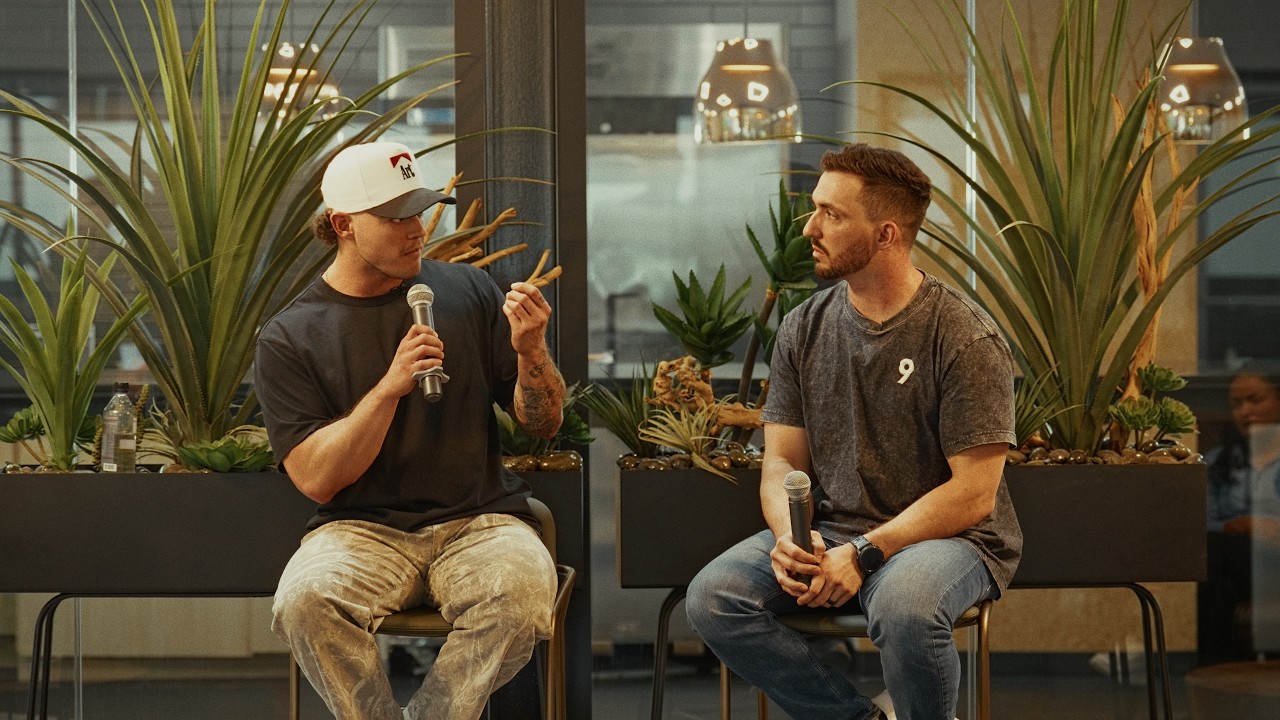
Recorded
June 19, 2026
At the room, Austin
Format
Fireside
Interviewed by Connor Cullip
Runtime
36 minutes
Filmed by Jacob Mizell
In short
Connor brought Bennett Looper to the June room to answer one question the whole evening was built on: how do you create meaningful attention, tell a story worth telling, and turn it into revenue. Bennett spent five years as a documentary filmmaker, much of it in the fitness world behind the camera, then turned the camera on himself. His answer is not a posting schedule. It is a set of core beliefs, a habit of leading with curiosity, and enough reps that the fear stops running the show. He had crossed a hundred thousand followers the day before he walked on stage.
You don't need a content strategy. You need a set of core beliefs.
The starter kit he told the room to buy
Bennett is not a gear head. When people asked what to shoot on, this is the short list he gave, in order of what matters.
Your phone
Unless you have at least two thousand dollars for a camera setup, shoot on your iPhone.
In this talkThe phone lets you film without looking like an influencer, which is the real barrier for most people.
A good mic
If you invest in one thing, make it a high quality microphone.
In this talkAudio is everything. A beautiful image no one can hear or understand is one nobody watches.
A tripod
Phone, mic, tripod is the killer combo. That is the base.
In this talkThe setup that removes the excuse. Nothing left to buy before you start.
Light and the rule of thirds
Shoot at golden hour or by a window. Put yourself on the grid, head near the top third.
In this talkThe two free upgrades. Soft light and clean framing before you spend a dollar.
What to take from it
- 01Core beliefs, not a content strategy.Make every post answer one of four questions: who you are, where you are going, what you are about, and why you do what you do.
- 02Lead with curiosity, not judgment.Curiosity is the root of all storytelling. Ask simple questions, then turn them on your own life.
- 03Nothing works until you do.Authenticity is reps. You will be cringy at first. That is the price, and everyone pays it.
- 04Talk to one person.Every time the camera turns on, picture a specific person. Bennett speaks to his younger self.
- 05Your why has to beat your fear.The fear never leaves. If your reason is views or brand deals, you quit. If it is real, you last.
- 06Not sharing is the selfish part.A little expertise makes you an authority. You do not have to be the ultimate one to help someone.
Top three action items
Where to start this week, straight from what Bennett told the room.
Write your four questions
Answer who you are, where you are going, what you are about, and why you do this. Point your next posts at those, not a calendar.
Buy the simple kit
Phone, mic, tripod. Spend on the mic first. Stop waiting for the perfect camera you already have in your pocket.
Do the reps
Record and post several videos this week, each one talking to a single person. Let the early ones be rough.
The short answer: you tell your story on social media by trading the content strategy for a set of core beliefs. Decide on the few things you stand for, make each piece of content answer one real question about yourself, and lead with curiosity instead of judgment. Keep the gear simple, put audio first, and get enough reps that authenticity stops being a performance. The story is the volume of all of it over time, not any single post.
Who is Bennett Looper
Bennett Looper is a filmmaker turned creative entrepreneur. He spent the previous four to five years behind the camera, much of that time telling one company's story in the fitness world, working closely with a figure he described as the pioneer of much of the modern fitness industry. Then he turned the camera around on himself and started telling his own story from the opposite side of the lens. Connor Cullip, who hosts the Network of Directors room in Austin, was introduced to Bennett through a member of the gym about thirty days before the event, resonated with his message, and flew him out. Bennett had crossed a hundred thousand followers the morning of the event. Being a filmmaker first, he said, is what shaped how he articulates and tells a story now.
What makes a good story, and how do you tell your own?
Behind the camera on documentary shoots, Bennett had to direct the narrative by talking to his subjects, usually athletes, and people freeze when a camera is in their face. So he had to master conversation from the hardest possible position. The way you have a good conversation, he learned, is you ask questions. Simple ones. What are you doing today, why are you doing this, what brings you here. And curiosity, he found, is not just good manners, it is the engine of the whole thing.
Curiosity is the root of all storytelling. So if I can take those questions and flip them around on my life, that's how I'm going to tell my story.
His interview style, the one he told Connor about on the phone before the event, is a motto: lead with curiosity, not judgment. To him curiosity is love and judgment is condemning, so the same posture that gets a nervous athlete to open up is the one you use on yourself when you sit down to make something.
Lead with curiosity, not judgment.
Do you actually need a content strategy?
Bennett works with a lot of type A people who want the plan handed to them: post this Wednesday, that Thursday, laid out in advance. The complaint he hears most is I do not know what to post, and if I just post my different interests it will look random. His answer flips the whole premise.
You don't need a content strategy. You need a set of core beliefs.
The core beliefs come from four questions you answer about yourself: who are you, where are you going, what are you about, and why are you doing what you are doing. If a piece of content answers one of those, it belongs. And no single post carries the story on its own. He reached for The Office to explain it: any one episode stands alone and you can enjoy it out of order, but it is the volume of all of them across nine seasons that makes the story. Social media works the same way. Each post answers something true about you, and the accumulation over time is the message.
What gear do you actually need to start?
Bennett is quick to say he is not a gear head, and that people overthink equipment. The best tool is the one you have, which for almost everyone is the phone. His whole kit is short.
Phone, mic, tripod is like the killer combo. Unless you have at least $2,000 to invest in a camera setup, use your iPhone.
The phone also solves the real barrier, which is not resolution but nerve: nobody wants to look cringe filming themselves in public, and a phone lets you do it without announcing it. If you are going to spend on anything, spend on audio. A gorgeous image is worthless if the viewer cannot hear or understand you. After that comes light, soft light from golden hour or a window, and simple framing, putting yourself on the rule-of-thirds grid with your head near the top. But most people, he warned, believe they have to master all of that before they start, when in reality it is never going to be perfect and the point is to begin.
How do you make content that feels authentic?
Authenticity, for Bennett, is not a setting you switch on. It is reps. He got there by doing ten thousand of them, yapping into a camera and leaving in the likes and the ums and the pauses, because you say those things in real life anyway. There is no shortcut around the awkward early phase.
Nothing works until you do. You're not going to get better until you just do the damn thing. And that takes sucking.
The other half of authenticity is direction. He believes you should be speaking to one specific person every single time you turn on the camera. It can be a target customer, a friend, a parent. For him it is often his younger self, the version who could not take risks or sit in discomfort, because if he went through those things, someone watching has too. And he is blunt that trying to be someone other than yourself backfires: your first audience is your friends and family, and they will feel it the moment your speech patterns change into someone else's.
How do you get past the fear of posting?
The most common thing that stops people, Bennett said, is not skill. It is fear, and the fear does not go away, so you cannot wait it out. The only thing strong enough to move you through it is your reason for doing the work in the first place.
Your why has to be stronger than your fear because that fear is never going to go away.
If you are posting for the views, the likes, or the brand deals, he said, you will not last, and he can usually sense it. His own why is that he knows his gifts, creating and articulating and leading by example, and he would be doing himself a disservice not to use them. He also reframed the fear of looking self-promotional. Sitting on knowledge that could help people is the selfish move, not sharing it. And you do not have to be the top authority in your field to have something to say.
Just because you have a little bit of expertise, you're by definition an authority. You might not be the ultimate authority, but you have authority to share.
How do you handle hate comments?
An attendee who had grown his own page asked how Bennett deals with the your-mic-sucks, your-haircut-sucks comments that arrive once you get any reach. Bennett split them in two. If there is anything practical in the comment, he takes it as data and makes a better decision, the same way a jab about a bad mic is really just a reason to buy a better one. The rest is an exercise in thickening your skin, which he considers a trait every successful person needs, and which being vulnerable online builds faster than almost anything. Underneath it is the mindset he keeps about which rooms to be in.
If I'm the most experienced and the most successful person in the room I'm in the wrong room.
Connor added the community angle: leave the negative comment up, let your audience rally, and turn the whole thing into content. Negative attention is still attention.
What is the hardest part of the business right now?
Connor does not let speakers stand on stage and list their follower counts, so he pushed Bennett on the honest struggle. Bennett was transparent: he is a creator at heart, and the hard part is scaling one to many without losing the thing that makes it work. He runs a high-ticket mentorship and a small cohort, both intimate by design, because that is where he thinks creativity actually unlocks. So the next level for him is building a team and learning to let go, which for a self-described perfectionist and former filmmaker is the real work. He is candid that filmmakers are the worst at overthinking their own content, because their taste is so high they feel like they are failing if it is not a full production. His release valve is a reminder he repeats to himself.
It's social media. It ain't that deep. Being imperfect is okay and it's still done.
He has even made peace with the perfectionism on long form, realizing people mostly just want to hear him talk, the way he himself half-watches a video while doing laundry. Lower the stakes, raise the volume, and get to the next one.
Quotes are from the recording, trimmed of filler. Nothing is added.
Frequently asked questions
What is the main idea of Bennett Looper's talk?
You do not need a content strategy, you need a set of core beliefs. Make every piece of content answer one of four questions about yourself: who you are, where you are going, what you are about, and why you do what you do. The volume of that over time is your story.
Do you need a content strategy to grow on social media?
No. Bennett's position is that a content calendar is the wrong thing to chase. Decide on a few core beliefs, lead with curiosity, and post consistently. If each post answers a real question about who you are and why you do the work, the strategy takes care of itself.
How do you tell a good story about yourself?
Lead with curiosity, not judgment. Curiosity is the root of all storytelling, so ask simple questions, then turn those same questions on your own life. Speak to one specific person every time the camera turns on, often a younger version of yourself.
What camera gear do you need to start making content?
A phone, a mic, and a tripod. Unless you have at least two thousand dollars for a camera setup, use your iPhone. Put audio first, because a beautiful image no one can hear does not work, then worry about lighting and framing.
How do you deal with hate comments?
Take the practical ones as data, the way a comment about a bad mic pushes you to buy a better one, and let the rest thicken your skin. Bennett's rule for growth: if you are the most experienced and most successful person in the room, you are in the wrong room.
Who is Bennett Looper?
Bennett Looper is a documentary filmmaker turned creative entrepreneur. He spent years telling other people's stories from behind the camera, including in the fitness world, then turned the camera on himself and now coaches creators and founders on telling their own story.

About Bennett Looper
Documentary filmmaker turned creative entrepreneur. He spent years behind the camera telling other people's stories, much of it in the fitness world, then turned the lens on himself. He now coaches creators and founders on telling their own story, through a high-ticket mentorship and a small cohort, and crossed a hundred thousand followers the day before he took the Network of Directors stage in Austin.
More voices from the room
Founders and operators who have taken the mic at Network of Directors in Austin.




Come to the next one
Friday, September 25, three to five in the afternoon, Austin. Free.
Save your seat