The third lever
How to grow a business without more leads
Mike Chu, business coach and founder of Champion Development. Interviewed by Connor Cullip at the Network of Directors room in Austin, Texas, on August 21, 2026, with a live coaching session for Matt Lupi of Simple Plan Austin at the end.
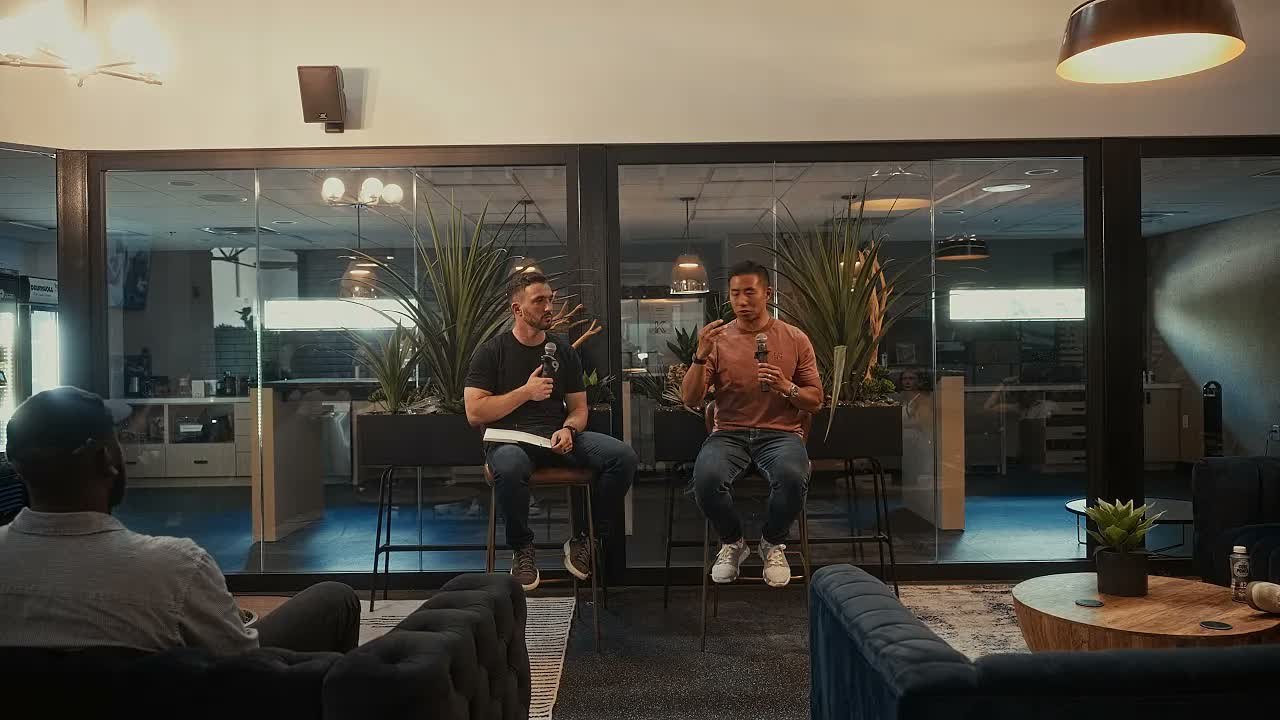
Recorded
August 21, 2026
At the room, Austin
Format
Fireside, then coaching
Interviewed by Connor Cullip
Runtime
About an hour and a quarter
Filmed by Jacob Mizell
In short
Connor's rule for anyone on this stage is that they come to give, not to pitch, and that they talk about their failures and not just their wins. Mike Chu asked for both before he was even booked. He is a dad of three, a five-time seven-figure CEO, and the founder of Champion Development, a coaching company that has made the Inc. 5000 five years running, and his business today is adding a million dollars of profit to companies that already work. The hour was about the lever most founders skip: not more leads, but getting the clients you already have to stay, pay, and stay longer. Then he did it live, coaching Matt Lupi of Simple Plan Austin through the three weeks he had to save his kitchen.
We're not in an attention economy. We're in a trust economy.
What Mike pointed to from the stage
The company, the framework, and the live case he built the hour on. Four places to go deeper.
Champion Development
Mike's coaching company for coaches, fitness professionals, and entrepreneurs, named to the Inc. 5000 five years running.
In this talkHome of the two programs he described: 7 Figure CEO, for founders whose business cannot yet run without them, and the LTV Accelerator, for established companies stuck at a ceiling.
VisitThe three ways to grow
Jay Abraham's rule that revenue only grows three ways: more customers, a higher average ticket, and clients who stay and buy again.
In this talkThe frame for the whole hour. The most valuable companies obsess over the third one, and most founders cannot put a number on it.
Simple Plan Austin
Matt Lupi's high-protein meal prep business, made in Austin and never shipped frozen across state lines.
In this talkThe live case. A co-packer gave Matt three weeks to get from about 450 meals a week to 750, and Mike coached him through it on stage.
ProfileOther people's audiences
Growing by getting the customers you already have to share, instead of paying for every new one.
In this talkHow Mike took a coaching business past two hundred thousand a month with six thousand followers, and the first move he handed Matt.
What to take from it
- 01Retention is a number, not a feeling.Founders know their close rate to a decimal and call retention "pretty good." Of every ten customers, how many buy again? One client was at 1.8. Now 4.5, and eight hundred thousand dollars of cash this year.
- 02Growth comes from what already works.A dime a hole that doubles every hole is over ten thousand dollars by the eighteenth. Lift show rate and close rate fifteen percent each and you are up a third with no new leads.
- 03A system is an outcome, not a task.The test is whether the result happens without you. His business kept growing for months after his father died, because leaders and systems carried it.
- 04The belief is the ceiling.Months of 98, 92 and 96 thousand and no way past 100. He cleared the belief behind it and hit six figures the next month, then every month for five years.
- 05Focus buys growth.After his first hundred-thousand-dollar month he spent 165 thousand on four coaches and the business flatlined. Find where the last thirty clients came from and cut the rest.
- 06Make the ask every time, and track the ask.Matt had never once asked a customer about the subscription. Mike's Houston business went from under ten memberships to eighty in ninety days by tracking one question.
Top three action items
Where to start this week, straight from what Mike told the room.
Put a number on retention
Pull your last hundred customers. Count how many bought a second time, or referred someone if you sell once. Write it down. That is the number you are managing now.
Find where the money already comes from
List your last thirty clients and where each one came from. Pour the next quarter into the top channel and stop feeding the rest.
Ask every buyer one question
At the moment of purchase, ask if they know about your subscription, membership, or repeat offer. Track whether you asked, not whether they said yes.
The short answer: you grow a business without more leads by working the third lever. Revenue only goes up three ways, more customers, a higher average ticket, and clients who stay and buy again, and most founders only ever pull the first one. Put a real number on retention instead of calling it pretty good. Study where your revenue already comes from and do more of that, better, before you add anything new. Define every system by the outcome it produces without you. And clear the belief that is quietly capping the number, because Mike could not break a hundred thousand a month until he did.
Who is Mike Chu
Connor opened with why Mike was on the stage at all. On their first call, Mike asked for two things: a chance to give real value without pitching, and room to talk about his failures and not just his wins. Both are Connor's own rules for the room. Asked to tell the room what he does, Mike skipped the two-paragraph bio. He is a dad of three, he invests in real estate and buys businesses, and his main company is in the business of adding a million dollars of profit to companies that are already working. He grew up in a family of teachers and karate schools, won a dozen national karate titles, and got his start in sales at nineteen selling Cutco knives, a job he kept for eleven years. Before the interview, two short segments set the table: Micah, a website builder, walked through what a modern site looks like, and Justin Day of SwarmSystem covered what it takes for a website to be ready for agentic search.
Owner, not operator
Connor asked about the two programs at Champion Development. Mike said it is less about the offers than about the pattern behind them. Every business he ran hit the same wall between one and five million, where more marketing and more email produced ten percent a year and a lot of volatility. Every one that took the next real jump did it by getting more efficient at sales and by getting clients to stay longer and pay more often. That is how companies growing ten to twenty percent a year have grown a hundred.
7 Figure CEO is for the founder who has not yet built the leadership and systems for the business to run without them. He borrowed the Tony Robbins line that operators get exhausted and owners get wealthy, and admitted he was the trapped one for years: a national karate champion who got badly out of shape and stopped seeing his family once he started a business.
I find most business owners are building a business that they are trapped within.
The reason it matters was the hardest story of the night. A few years ago, flying home to New Jersey to see his parents, he got a call in the New York airport telling him his father had died. He did not touch his business for months. It kept growing, because leaders on his team and the systems behind them carried it. Then he gave the room his definition of a system, which is not the one most people use.
A system is just defined by the outcome, not the task. Can an outcome and a result be produced without you?
A task getting done, he said, is not the same as the business growing, and a lot of the AI tooling founders are building right now is a task machine that has changed nothing.
The third way to grow
The LTV Accelerator, his second program, is for established businesses that are doing more marketing and growing five percent a year. To explain it he went to Jay Abraham, the business strategist Tony Robbins learned from, who boiled growth down to three moves.
There's only three ways to increase revenue. Get more customers, increase your average ticket, and number three, which the most valuable companies in the world understand and the least valuable ignore: how to get clients to stay, pay, and stay longer.
Verizon, Amazon and Netflix obsess over acquisition, he said, but they are more obsessed with lifetime value. He told a story from lunch with Austin Distel, who spoke here in July, about a channel at Jasper that was bringing in real money and, as Mike heard it, got cut anyway because the lifetime value of those customers was poor. Valuable companies know their number. Then he gave the room the definition, which he keeps simple: lifetime value is how many customers buy once and then buy again, measured at least once a year. He cited Hormozi's floor, that if six of every ten customers are not buying again, your LTV is broken. And then the discrepancy he sees everywhere.
If you ask people how their front-end stuff is, they'd be able to tell you their closing ratio to a percentage. And yet when I ask people how their retention is, they use phrases like good, great, or pretty good. That's not a measurable way of defining success.
His case was a five-million-dollar business increasing ad spend while its return fell. The founder said retention was pretty good. The real number was 1.8 of every ten. Mike's team took it to 4.5, and it has added eight hundred thousand dollars of cash to the business this year so far. The operator's note back was that it is the most profitable revenue they have ever generated, because they pay nothing to acquire it. The founder now expects retention revenue to match front-end revenue within two years, which would double the company.
For a one-time purchase, a fence, a house, a roof, measure lifetime value by referrals per client instead. He had just come from Tony Robbins's Business Mastery, still hoarse from it, where the same point was made about real estate agents who close a four-million-dollar house and never call the client again. Which is where the line about trust came from. A raving-fan culture, he said, is how a business takes on a life of its own.
The month he could not break
Connor took him back to the start. Mike was working at Pizza Hut for beer and gas money, a shy kid, when he landed a commission-only sales job at nineteen. The lesson he took from eleven years of direct sales was not how to handle rejection.
Everything that happens outside of me is a direct reflection of me.
Two rules came out of that. Stand guard at the door of your mind every day, because your thoughts become your reality. And you do not get what you say you want, you get what you expect, and your expectations are a byproduct of who you have become.
The story that proved it to him was trying to reach a hundred thousand dollars a month in 2009 and 2010. The business did 98, then 92, then 96, and could not get over the line. His grandparents were farmers and he was wired to work harder, and at 96 he could not see how harder was going to find the last four. Then he looked at the belief underneath. His father had mocked people who made money his whole childhood, and somewhere Mike had decided that a son making a hundred grand a month would be a problem at home. Once he addressed that, they did a hundred thousand the very next month and every month for the next five years. The same belief came back in a new business in 2019.
There comes a point at a certain level of success where working harder is not what gets you to the next level.
Connor asked how it felt to see the number. Mike was honest: he was drinking heavily at the time, did not feel much of anything, and mostly thought about what he had to do next.
Why celebrating is not optional
This became the most personal stretch of the night. Connor shared that the first month he made a hundred thousand dollars in mortgage income, his father's response was that he had only done twelve million in loans that month, so why not twenty-four. Mike's answer was that celebration is the highest form of gratitude, that professional athletes understand it and business owners mostly do not, and that Kobe Bryant's father telling him "whether you score zero points or eighty points, we love you" is what let Kobe chase greatness for its own sake. Mike threw his first birthday party this year since he was six.
Then he had the room go around and shout out a win. A founder who sells solar admitted his fear: if he celebrates, he takes his foot off the gas and it all goes away. Mike coached him on the spot. Nobody climbs Everest in one push. Base camps exist so you can celebrate the progress and reset for the next stretch, and if you are playing a long game, celebration is a must, not a chore. And the fear itself says something: you do not trust yourself to put your foot back down when it is time.
The better it gets, the better it keeps getting. I used to think what goes up must come down, so I was always living my life with this when's-the-other-shoe-going-to-drop energy.
Growth from what already works
Connor pulled a line from Mike's content: growth comes from what is already working and becoming more efficient. Mike's illustration was golf at a dime a hole, doubling every hole. By the ninth hole nobody blinks. By the eighteenth, the dime is more than ten thousand dollars a hole. That is what small tweaks compound to.
We underestimate what micro tweaks in our business will lead to. If we just got our show percentage up fifteen percent and the closing percentage up fifteen percent, do the math. That's so much more important than just get more leads.
He has taken businesses up thirty, fifty and a hundred percent without a single lead more than they already had, by moving levers that already existed. For the founders wired to bang on the wall harder, that was the whole message.
Shiny objects and the data
Connor confessed to ten businesses and a habit of starting a new one every time he had an idea, now down to two. His question: at five or ten thousand a month, how do you pick the one thing? Mike's own lesson came right after his first hundred-thousand-dollar month. One coach had gotten him there, so he hired four, put a hundred and sixty-five thousand dollars into masterminds and mentorships the next year, and the business flatlined in the middle of hockey-stick growth.
If I just focus on the thing that's working already and keep doing it better, we're probably going to keep growing faster than me trying to introduce seven new projects.
His method is to let the data dictate the decision. Where does the majority of revenue come from, and what could you cut to buy more focus for it? He gave the example of clients posting on every platform at once whose last thirty customers turned out to be 82 percent from Instagram and the rest from email. Stop posting on Facebook. Get better at Instagram, then do more of it.
The live coaching session with Matt Lupi
Two months earlier Austin Netzley had coached Bennett Looper on stage, and Connor wanted to try it again. He played a video Matt Lupi, owner of Simple Plan Austin, had posted that week. Matt had handed production to a co-packer, the co-packer needed 750 meals a week to keep him, and all summer he had been at 450 to 500. Three weeks. Justin Day interviewed Matt for a few minutes first: the food is made in Austin, very high protein, the best week was 855 back when a group of NFL draft prospects were ordering 250 a week, and the goal is a thousand.
Then Mike took the seat, and the session is worth watching whole. He started with commitment, not tactics. On a scale of one to seven, how much was Matt treating 750 like a must? Five, Matt said, because there were ways around it. Mike pointed out that he had a plan B in his head and had taken no action on one. A founder finds the treasure, he said, when they believe it is out there, believe it is worth it, and treat finding it as a must.
Any strategy is not effective if the founder isn't treating it like a must.
Then the data. Matt had already hit 750 that week off two Instagram posts and a wave of shares, eighteen new customers in twenty-four hours. Fifty-five percent of his customers buy again. Margins are forty percent. Ads cost him twenty-seven dollars a customer. A meal is $10.99. The subscription discount was five percent, and Matt had never once asked a customer about it. His first touch after an order had always been a Google review request.
I forget tracking the conversions for now. Just control the controllables. Did we ask? Hit a hundred percent on making the ask.
Mike's prescription, in order. Repeat what worked: a part two and part three of the video. Turn buyers into other people's audiences by offering three free meals to anyone who posts their order and tags the business, which costs less than the twenty-seven dollars he pays Meta. Call or text every one-time buyer personally while the business is still small enough to do it. Ask about the subscription at the moment of purchase, again the next Thursday, and again the following week, and track the ask rather than the yes. His Houston business went from under ten memberships to eighty in ninety days by tracking that one question. Add an order bump at checkout, where sixteen to eighteen percent typically opt in, and text the rest within a few hours while the purchase is still emotional. And with forty percent margins, test ten or twenty percent off for members instead of five. His two homework items: track whether every first-time buyer was asked, and make a hundred asks to a hundred people in Austin to share the story.
Quotes are from the recording, trimmed of filler. Nothing is added.
Frequently asked questions
What is the main idea of Mike Chu's talk?
Revenue grows three ways, more customers, a higher average ticket, and clients who stay and buy again, and most founders only ever work the first one. Put a real number on retention, fix what already works before adding anything new, and clear the belief that is quietly capping the number.
What is LTV, and how do you measure it?
Lifetime value is how many customers buy once and then buy again, measured at least once a year. Of every ten customers, count how many came back. If you sell something people only buy once, count referrals per client instead. Good, great, and pretty good are not measurements.
What are the three ways to grow a business?
Jay Abraham's rule, which Mike built the talk on: get more customers, raise your average ticket, and get clients to stay, pay, and stay longer. The most valuable companies obsess over the third one and most small businesses ignore it.
How do you decide what to focus on?
Let the data decide. List your last thirty clients and where each one came from, then pour your time into the top source and cut the rest. Mike's own business flatlined the year he spread himself across four coaches and a hundred and sixty-five thousand dollars of masterminds.
What happened in the live coaching session?
Connor brought up Matt Lupi of Simple Plan Austin, who had three weeks to get from about 450 meals a week to 750 or lose his production kitchen. Mike coached him on stage: repeat the post that worked, reward buyers for sharing, ask every customer about the subscription and track the ask, add an order bump, and test a bigger member discount.
Who is Mike Chu?
A business coach and five-time seven-figure CEO based in Austin. He is the founder and CEO of Champion Development, a coaching company named to the Inc. 5000 five years running, and he runs the 7 Figure CEO and LTV Accelerator programs.

About Mike Chu
Business coach and five-time seven-figure CEO. Founder and CEO of Champion Development, a coaching company for coaches, fitness professionals, and entrepreneurs that has made the Inc. 5000 five years running. He sold Cutco for eleven years, built the Health and Wealth Academy past two hundred thousand a month, and now runs the 7 Figure CEO and LTV Accelerator programs, adding profit and time freedom rather than just revenue.
More voices from the room
Founders and operators who have taken the mic at Network of Directors in Austin.


Come to the next one
Friday, September 25, three to five in the afternoon, Austin. Free.
Save your seat