Ugly converts
How to build marketing that drives revenue
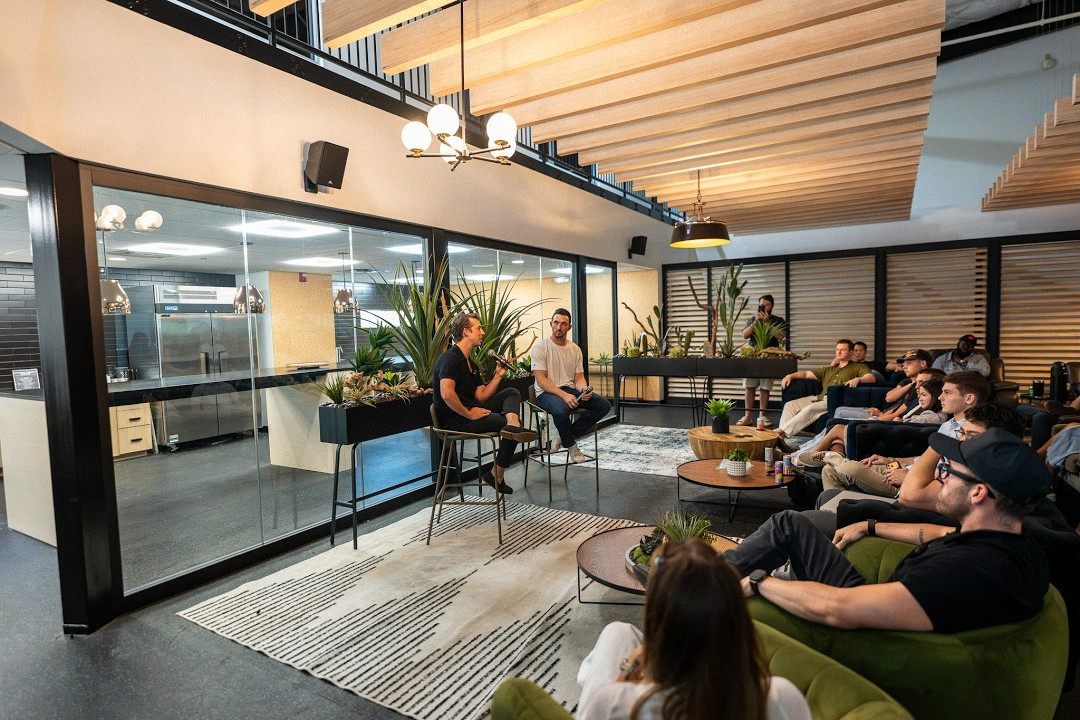
Austin Distel, former CMO of Jasper and creator of Agentic Society. Interviewed by Connor Cullip at the Network of Directors room in Austin, Texas, in July 2026.
Recorded
July 2026
At the room, Austin
Format
Fireside
Interviewed by Connor Cullip
Runtime
About an hour
Filmed by Jacob Mizell
In short
Connor brought Austin Distel to the room because his story sits right in the lane of the whole series: attention that turns into revenue. Austin was on the founding team at Jasper, the AI writing company that went from an autocomplete demo to a $1.5 billion valuation in eighteen months, and as CMO he helped acquire its first hundred thousand paying customers with a marketing team of two. The hour was a working masterclass: make every channel feed the others, borrow other people's audiences, let your customers do the selling, and stop confusing pretty with profitable.
The best written copy is from your customer's mouth and not yours.
What Austin pointed to from the stage
The companies and ideas he built his lessons on. Four places to go deeper.
Jasper
The AI writing platform Austin helped build from a GPT-2 autocomplete demo to a $1.5 billion company.
In this talkThe case study under everything: the founding story, the growth engine, and the rebrand from a Marvel cease and desist.
VisitAgentic Society
Austin's in-person society in Austin for owners building a fleet of AI agents to grow revenue without growing headcount.
In this talkWhere he spends his time now. It meets twice a month on Fridays for training and show-and-tell.
Y Combinator
The Silicon Valley accelerator where his team found product-market fit and raised their seed round.
In this talkThe lesson he still uses: talk to thirty customers, and hunt the first ones instead of farming them.
VisitProof
The website notification tool his team built in 2016 that showed live activity on a page.
In this talkHis first proof that social proof pays: a customer quote lifts conversion about fifteen percent over your own claim.
What to take from it
- 01Make every channel work together.SEO, email, paid, affiliates, social. In a silo each is weak. Recursive, they compound. He ran forty-eight million a year with two marketers.
- 02Let your customers sell for you.Package their reactions into your ads. He reached a million dollars in revenue without ever showing the product.
- 03Ugly converts.A red arrow on a screenshot beats a beautiful photo. Beautiful positions the brand, ugly collects the money.
- 04Hunt your first thirty.The first thirty customers is a hunt, not a farm. Thirty is where a pattern becomes real, and long conversations teach you what to build.
- 05Borrow other people's audiences.Recruit a guest expert, go live once a week, and turn that hour into a landing page, an email sequence, ads, and an affiliate.
- 06Concise clarity beats creative cheekiness.A plain-text email from a person, not a company, crushed a franchise's sales goal in a single day.
Top three action items
Where to start this week, straight from what Austin told the room.
Wire your channels together
Take one campaign and make it feed SEO, email, ads, and an affiliate at once, instead of running four efforts that never touch.
Recruit one guest expert
Bring on someone with authority, go live, and let that one recording become a landing page, a nurture sequence, and your ads.
Sell the reaction, not the product
Collect three real customer sound bites this week and cut them into your next ad. Let their words do the selling.
The short answer: you build marketing that drives revenue by refusing to run channels in silos and by handing the selling to your customers. Make SEO, email, paid, and affiliates feed each other so the work is recursive. Borrow other people's audiences, knowledge, and time through a weekly guest expert. Package customer reactions instead of describing your own product, and use ugly, direct creative to collect money while beautiful creative positions the brand. Judge all of it by sales, not by how it looks.
Who is Austin Distel
Austin Distel lives in Austin, Texas, which every Uber driver tells him is a unique name for the city. He moved here with seven friends after Y Combinator to chase the tech startup life, and Jasper grew out of that same group. He describes himself simply: he loves marketing, revenue, sales, and entrepreneurship, and could talk about it all day. On stage that was not a boast, it was a warning, and Connor, who hosts the Network of Directors room in Austin, met him a couple of months before the event when Austin walked into his office and, out of pure curiosity, asked him every question about his business. That posture, leading with curiosity, turns out to be a thread through the whole hour.
How did Jasper actually start?
The company that got them into Y Combinator stalled out around two hundred fifty thousand dollars a month for years, until the CEO decided they had to look at new technology. Over a Christmas break in 2020, their YC connections got them access to GPT-2, years before ChatGPT, when all it could do was autocomplete a sentence. The team had spent years building marketing software, so they solved their own problem first: the endless treadmill of new Facebook ad creative. What if AI could write ad copy the way the copywriting greats did? They spun up a Facebook group of marketing agency owners and offered to write their clients' ad copy in the comments. No product, just proof.
Imagine copying and pasting right now from chat. Now, chat wasn't a thing yet. Our engineering team is taking the sandbox output and doing this huge prompt to then give in a Facebook group that output.
Their first customer was his roommate, who paid a hundred bucks, a round number because they had no idea what to charge, for a custom AI use case writing Amazon listings. It worked, the comments piled up, and they turned it into a product called Conversion.ai. By thirty days they were at thirty thousand a month, by ninety days ninety thousand, and the community started calling the tool Jarvis. So they leaned in and renamed it, which is when Marvel's lawyers sent a cease and desist over the Iron Man trademark. An eighty thousand dollar domain went to waste and a hundred thousand backlinks had to be redirected, but Austin made the pivot fun with a Thanos-snap email campaign and they doubled in the next sixty days. That redirect turned into an SEO project that retained ninety-eight percent of their backlinks, and SEO ended up accounting for about a quarter of Jasper's growth.
How do you make every channel work together?
As CMO, Austin refused to think about channels in isolation. The question he asked was how to make each one as effective as possible not on its own but as part of a loop.
How do I make every channel as effective as possible not in a silo but in working together so that the work is recursive. It keeps looping on itself.
How does SEO help conversion, which helps paid traffic, which helps affiliates, which helps influencers and social. He wanted them all pulling on each other, and he did it with himself and one other marketer while the company grew by hundreds of customers a day and passed forty-eight million a year in revenue by the end of year one. By eighteen months they were at a hundred thousand paying customers. None of the channels, he said, would have carried that alone. Together they did.
What was the one-hour-a-week growth engine?
Every week Jasper had a new use case to promote, email, SEO, paid, and no way for two people to create all that content. So Austin asked the question he asks himself constantly, what would it look like if it were easy, and built a machine around a guest expert. Each Thursday he went live with someone who was a keynote name in that week's topic, framed as the AI-powered keynote speaker, who brought their own audience and even wanted to influence the product. Then he turned that single hour into everything else.
I borrowed other people's audiences to grow my email list. I borrowed other people's knowledge to promote my product, and I used other people's time to build a sales video sales letter.
Monday and Wednesday emails promoted the live session. The recording went up on a landing page built for that topic, great for SEO. It entered the email nurture sequence for every new lead. Paid ads retargeted anyone interested in the topic. And the guest became an affiliate on thirty percent recurring, which drove a quarter of Jasper's growth. One hour on a Thursday, every channel optimized, and by the end of the year a million-person email list. Over twelve months that rhythm produced fifty-two videos, fifty-two landing pages, and fifty-two emails, a full conversion sequence working across every channel at once.
How do you get customers to sell for you?
Austin's rule for positioning is a bar. Walk in and yell that you are the best mortgage company in America and everyone decides you are full of it. Have someone in the corner say it about you, and the whole room believes it. The same thing happens on camera. Most people open a video with "Hi, this is my name with my company," which puts up the audience's fences immediately. Lead with value and the five-second hook instead, and let a referral partner point back at you. He even shared the hack of adding an interview subject as a co-contributor on Facebook, so the video posts to their timeline as if they shared it, and you borrow their audience from scratch.
The deepest version of this was how he sold Jasper before it had much of a product. In onboarding calls the customer success team recorded the moment a professional copywriter's eyes lit up at the output. Austin collected those three and five second reactions, compiled them into a thirty second ad with no product shown, and kept doing it.
We got to a million dollars in annual revenue without showing the product. You don't need to promote what you actually do. You need to showcase that other people are excited about what you do.
All of it was true, he stressed, just told through the customer's mouth instead of his own, which is where the best copy always comes from.
Does ugly really convert better than beautiful?
This is the line that made a designer in the room wince, and Austin owned it. He is a brand and creative marketer by taste, but the results are the results.
A giant red arrow on a black and white screenshot is going to convert higher than your beautiful high resolution photo. It's a pattern interrupt, and it's going to be a money collector.
He is not against brand. The most he ever spent on a Jasper commercial was five hundred thousand dollars on a beautiful Pixar-animated spot, and it was the worst performing ad creative they owned, yet it set the brand tone, positioned them as legitimate, and helped recruit a team whose executives have since taken companies public. So the two do different jobs. When you are converting traffic, ugly works. When you are positioning yourself in a market, beautiful works. He proved the point after Jasper by buying a chain of spas: the franchise's gorgeous creative made them look legitimate but converted poorly, while a plain-text email from his receptionist's name, not the company's, crushed the company's sales goal in a single day.
Concise clarity beats creative cheekiness.
How do you find your first customers?
Austin's number for the early days is thirty, and it is not arbitrary. Thirty is the point in statistics where a pattern becomes significant, which is why YC pushes founders to talk to thirty customers a week. His motto across every company was that the first customers are earned by hand.
You're going to hunt your first 30 customers. You're not going to farm them.
That means the front lines, the DMs, the calls and emails, not a social post hoping for signups, because an hour-long conversation teaches you more than any amount of posting. And it requires a specific kind of courage.
The willingness to look stupid is the cost of success.
In the very early days Jasper did not even have self-checkout, so they posted that they were accepting five new members and grew a waitlist in the Facebook comments, assigning people a number in line. It looked like scarcity marketing, but it was really a seven-person team without the infrastructure to onboard everyone at once, using the constraint to learn from every onboarding call.
Where is marketing going, and what is Agentic Society?
Asked where AI takes marketing, Austin was direct: small teams doing ten times the volume, with AI as the single most valuable skill you can add right now. But the tools do not change what marketing is really about.
Trust is paramount, and being the face is necessary. I don't think that faceless brands are going to work anymore.
He believes the winners build a community that feels tribal, that becomes part of a customer's identity, and that whoever gets closest to the customer wins. His example was a lotion company in Austin called Shelter that his wife is obsessed with, because the founder replies to every DM and improves every batch. That is also the thinking behind what he does now. After Jasper, he kept sharp by gathering friends every ninety days for in-person AI hackathons, and formalized it into Agentic Society, an in-person society in Austin for business owners.
How do I grow a company to get big revenue without having to grow my headcount to be bloated? What would it look like if you really got AI agents dialed in this year?
The society meets twice a month on Fridays for three hours of training and show-and-tell on using AI agents to automate work and scale revenue, and it is aimed at the leadership team, the people actually shaping how their company uses AI. What Connor valued about Austin's rooms, he said, is that they talk about the real output of AI and the tools people used to grow revenue, not another pitch to buy a product.
Quotes are from the recording, trimmed of filler. Nothing is added.
Frequently asked questions
What is the main idea of Austin Distel's talk?
Build marketing that drives revenue by making every channel work together instead of in silos, and by getting your customers to do the selling for you. Package their reactions, borrow other people's audiences, and remember that plain, ugly, direct marketing often converts better than beautiful marketing.
What is revenue marketing?
Marketing judged by sales, not aesthetics. Distel treated the landing page like an ATM and every channel as something that has to feed the others. Ugly, clear, direct response collects money, while beautiful brand work positions you in the market, and you balance the two.
Does ugly marketing really convert better?
Often, yes. A red arrow on a black-and-white screenshot converts higher than a polished, high-resolution photo, because it is a pattern interrupt. Beautiful creative positions the brand, ugly creative collects the money, and the skill is knowing which job you are doing.
How do you get customers to market for you?
Package their reactions. Distel compiled short customer sound bites into ads and reached a million dollars in annual revenue without ever showing the product. Lead with value and referral, not a company introduction, because the best written copy comes from your customer's mouth, not yours.
What is Agentic Society?
The in-person society Austin Distel started in Austin for business owners building a fleet of AI agents to grow revenue without growing headcount. Members meet twice a month on Fridays for training and show-and-tell on using AI to automate work and scale revenue.
Who is Austin Distel?
Austin Distel is the former CMO and a founding-team member at Jasper, the AI writing company that grew from an autocomplete demo to a $1.5 billion valuation. He helped acquire its first hundred thousand paying customers, then left at Series A and now creates Agentic Society in Austin.

About Austin Distel
Former CMO and founding-team member at Jasper, the AI writing company that grew from a GPT-2 autocomplete demo to a $1.5 billion valuation in eighteen months. He helped acquire its first hundred thousand paying customers with a marketing team of two, then left at Series A. He now creates Agentic Society, an in-person society in Austin for owners building a fleet of AI agents to grow revenue without growing headcount.
More voices from the room
Founders and operators who have taken the mic at Network of Directors in Austin.




Come to the next one
Friday, September 25, three to five in the afternoon, Austin. Free.
Save your seat