It really is consistency
How to start a podcast that grows your business
Abby Roberge, co-founder of Melrose Podcasts. Interviewed by Connor Cullip at the Network of Directors room in Austin, Texas, in July 2026.
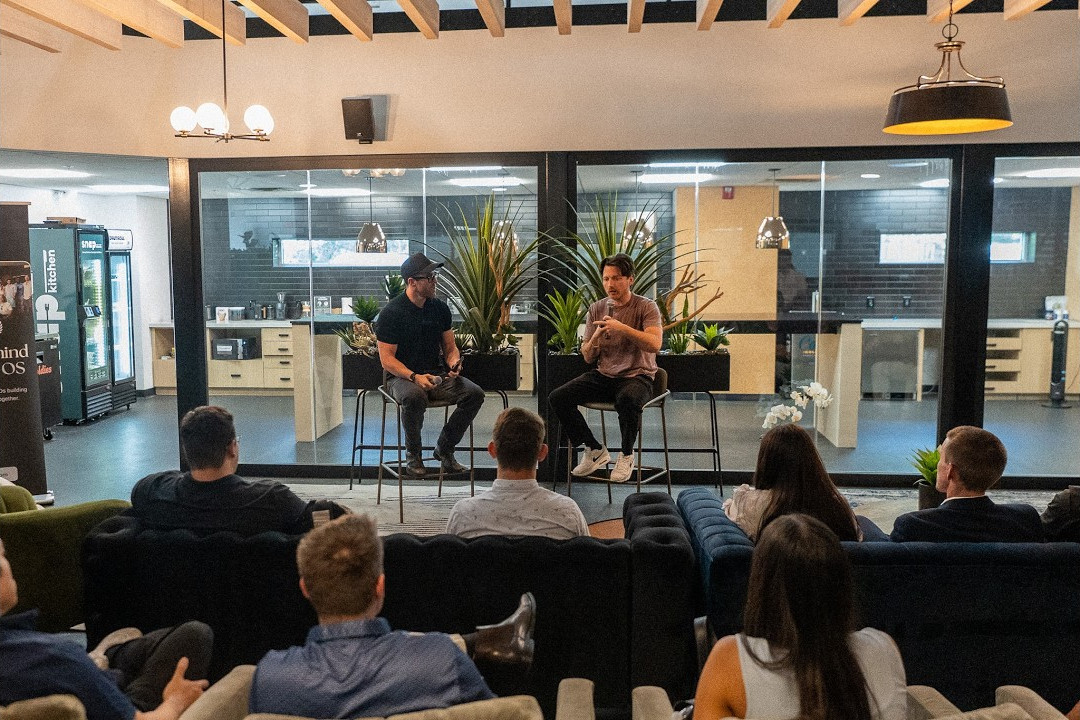
Recorded
July 2026
At the room, Austin
Format
Fireside
Interviewed by Connor Cullip
Runtime
8 minutes
Filmed by Jacob Mizell
In short
Abby Roberge took the mic for a short one, and it was dense. He and his business partner were two stand-up comedians who turned a makeshift garage studio into Melrose Podcasts, a production company with rooms in Los Angeles, New York, and Austin. In eight minutes he laid out what he has learned watching hundreds of shows start: a podcast is a small business, the long-form audience is the one worth building, consistency is what separates the shows that grow from the ones that vanish, and a business is better off running an unbranded show that earns trust than an ad nobody wants to hear.
A long-form audience is the most valuable audience by far. If you can even have 5,000 consistent long-form audience members, you can convert that into anything.
How podcasting has shifted, in his words
Roberge opened Melrose two months before the pandemic. Here is how the medium has moved since, and why he says to start now.
Audio and Apple
In 2020, everyone cared about audio and Apple Podcasts first.
In this talkThe starting point. It is not where the growth is anymore.
YouTube
Then it exploded on YouTube, which is where about eighty percent of your growth now comes from.
In this talkThe reason his studios shoot video, not just record audio.
Clipping
From there, clipping the long-form into short-form became the primary way shows grow.
In this talkWhy you record long and cut down, not the other way around.
UGC and VSLs
Lately a big rise in user-generated content and video sales letters, plus on-location work.
In this talkWhere the demand is heading, and where Melrose is getting a lot of its work.
What to take from it
- 01Treat it like a small business.A podcast gives back what you put in. Run it like a company, not a side project.
- 02Long-form is the valuable audience.Even five thousand consistent long-form listeners can convert into almost anything.
- 03Consistency separates the winners.The ones who blow up keep going. The ones who quit could not see how to monetize yet.
- 04Build the brand, not the ad.Run an unbranded show in your space. People can smell an advertisement and turn off.
- 05The relationships are half the value.An uninterrupted hour with someone builds a real relationship. Guests become friends and clients.
- 06Start now, the format keeps moving.Audio to YouTube to clips to UGC. Waiting for the perfect moment means missing all of them.
Top three action items
Where to start this week, straight from what Abby told the room.
Pick a cadence you can hold
Consistency beats production. Choose a schedule you can keep every week and commit to it for a full year.
Start unbranded
Build a show around your topic, not your product. Earn trust with the audience first, then brand it subtly.
Go long, then clip
Record the full conversation, then cut it into short clips. The long-form is what builds the audience that converts.
The short answer: you start a podcast that grows your business by treating it like a company, committing to a consistent long-form show, and building trust before you sell anything. The long-form audience is the one that converts, clips are how it spreads, and an unbranded show earns the attention that an advertisement never will. What you get back is content, relationships, and a channel that compounds if you keep showing up.
Who is Abby Roberge
Abby Roberge is a stand-up comedian and the co-founder of Melrose Podcasts. Connor Cullip, who hosts the Network of Directors room in Austin, introduced him as a good friend who shows up for everything and gives great advice, with a studio right upstairs at the venue. Abby and his business partner both came up as comedians, and that partner had helped start some of the shows that later blew up. What started as a favor to fellow comedians became a company.
How did Melrose Podcasts start?
The origin is humble. Abby and his partner were, in his words, borderline homeless comedians with no ambition, working out of a makeshift studio in his partner's garage. Abby's idea was to commercialize it: rent a real space so other comedians could come and record at an affordable rate. Their wildest dream was to cover the rent and maybe clear a thousand dollars a month. They opened two months before the pandemic, which wiped the business out for about six months, and then a break landed. A major podcaster moved to Los Angeles and started using their studio, which legitimized them, and higher-profile clients followed. The studio grew to three locations, in Los Angeles, New York, and Austin, and the guest list came to include Matthew McConaughey, Sylvester Stallone, Will Smith, and Neil deGrasse Tyson.
What kind of podcast is actually worth building?
When people come to Abby not knowing where to start, he tells them a podcast is like a small business: you get out what you put in. And he is clear about where the value sits.
A long-form audience is the most valuable audience by far. If you can even have 5,000 consistent long-form audience members following your stuff, you can convert that into anything.
The long-form is also where the relationships form, which he counts as half the point. He pointed out how rarely any of us sit down with someone for a full hour, uninterrupted and off our phones, and how many of his clients have walked out of a recording as genuine friends with the person across the table. You get the networking, you get a library of content, and you get to film somewhere better than a garage.
What separates the shows that grow?
Abby has watched a lot of business owners come through his studios, so Connor asked him the obvious question: what separates the ones who blow up from the ones who record once and ghost. The answer was not talent or gear.
It really is consistency. Some people will do it and it'll work and they'll just quit because they don't have the time or they don't see the way they can monetize it.
His proof is a friend who owns a large apparel brand and podcasted for a year with no monetization at all. Over that year he built real relationships and poured knowledge and trust into an audience of young, up-and-coming entrepreneurs. Then he opened a paid private group, and he is now making millions from that group alone. The show did not sell anything for a year. It built the thing that sells.
Should a business start its own podcast?
For owners in the room, Abby's advice was counterintuitive: do not brand it. People can sense an advertisement and tune out the moment they do.
I always like to convince businesses to start their own podcast that's not branded, because if people can smell something being an advertisement, they're going to turn off.
A supplement brand, he said, should not run a supplement commercial. It should run a health and wellness show, grow it, build as much trust with the audience as possible, and brand only subtly, so the connection to the business flows out naturally over time. As for making it, Melrose is built to take on as much or as little as a client wants, from the creative and filming through editing, posting, strategy, and clipping campaigns. But the part he wanted the room to hear was the mindset, not the service: pick something you can keep doing, and keep doing it.
Quotes are from the recording, trimmed of filler. Nothing is added.
Frequently asked questions
What is the main idea of Abby Roberge's talk?
Treat a podcast like a small business, not a hobby. Go long-form, because it is the most valuable audience you can build, stay consistent, and if you are a business, start an unbranded show that earns trust before it ever sells.
Is starting a podcast worth it for a business?
Yes, if you commit. A long-form audience is the most valuable audience by far, and even five thousand consistent listeners can convert into almost anything. You also get content, relationships, and networking out of every episode you record.
What separates podcasts that grow from ones that quit?
Consistency. Roberge has watched owners quit because they do not have the time or cannot see how to monetize yet, while the ones who keep going build relationships and trust over a year and then turn that into real revenue.
Should a business start its own podcast?
Roberge recommends starting an unbranded show, because people can smell an advertisement and turn off. A supplement brand, for example, should run a health and wellness show, build trust with the audience, and brand only subtly.
Who is Abby Roberge?
Abby Roberge is a stand-up comedian and co-founder of Melrose Podcasts, a podcast production studio that grew from a garage into three locations in Los Angeles, New York, and Austin, hosting guests from Matthew McConaughey to Neil deGrasse Tyson.

About Abby Roberge
Stand-up comedian and co-founder of Melrose Podcasts. He and his business partner turned a garage studio into a production company with rooms in Los Angeles, New York, and Austin, hosting guests from Matthew McConaughey to Neil deGrasse Tyson. His Austin studio is upstairs at The Kollective, and Melrose handles as much or as little of a show as a client needs, from filming to editing to clipping.
More voices from the room
Founders and operators who have taken the mic at Network of Directors in Austin.


Come to the next one
Friday, September 25, three to five in the afternoon, Austin. Free.
Save your seat